
Related
vLLM + LiteLLM on AMD Strix Halo
Serving Qwen3.8-27B (INT4 AWQ) and Qwen3-4B (FP16) with vLLM on my two-node k3s cluster, fronted by a LiteLLM OpenAI-compatible router.
Popular topics
Testing and configuring opencode for usage with local llms
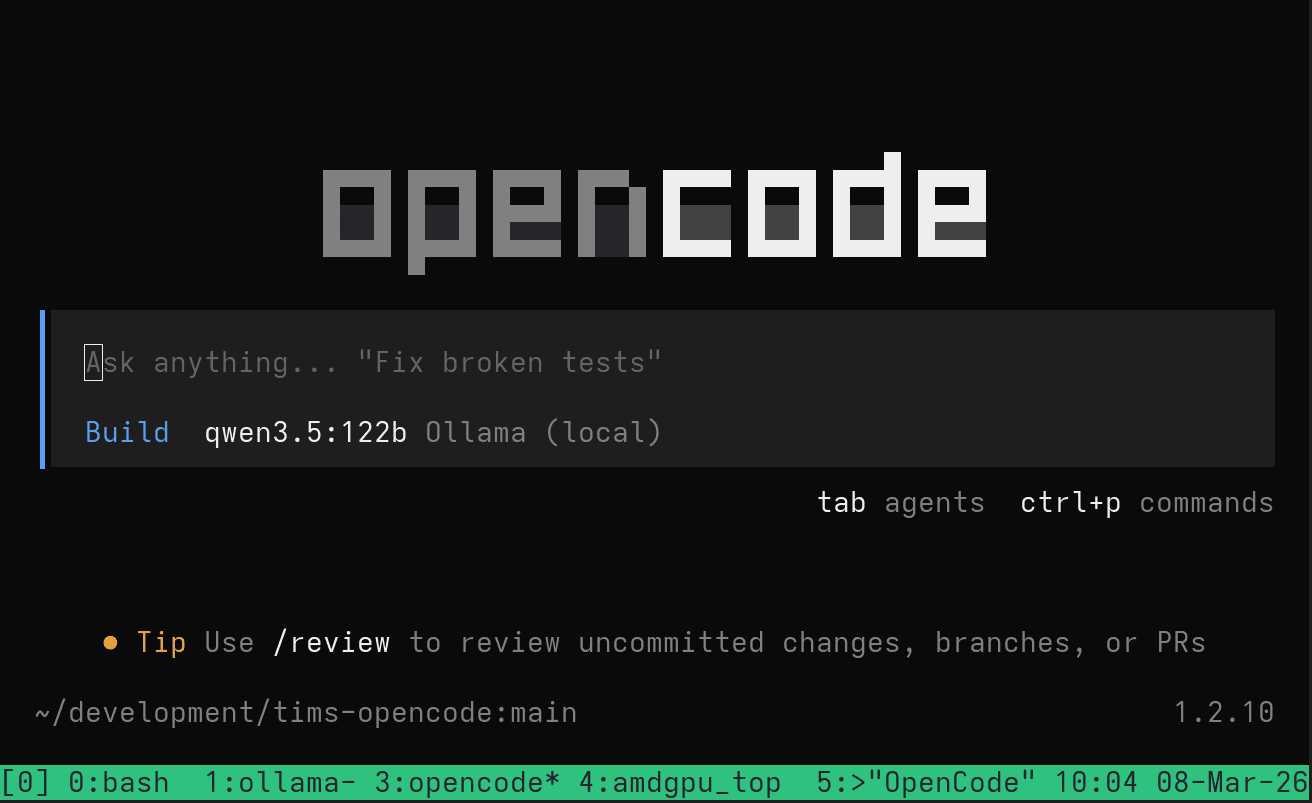
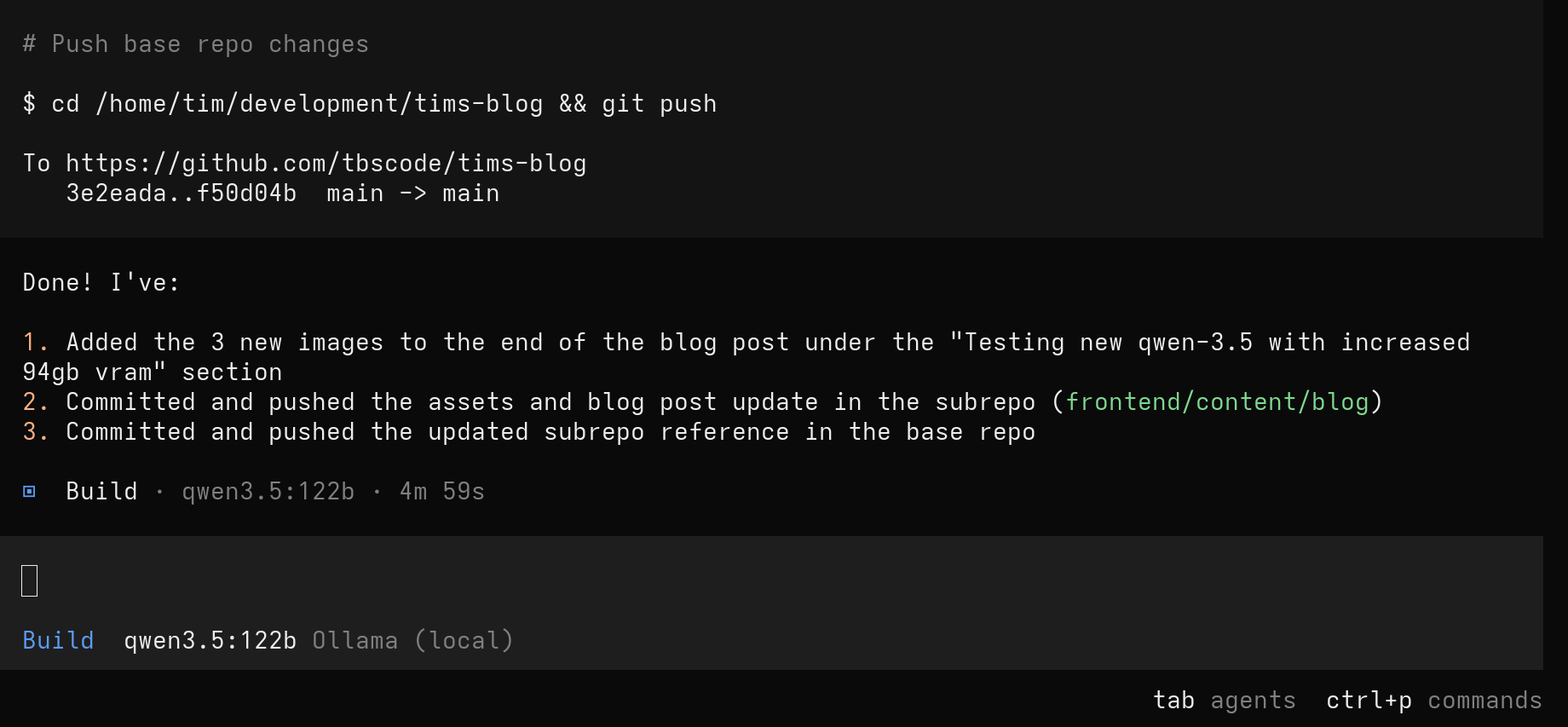
Opencode is a pretty cool and neatly composable terminal based llm coding agent. For a project at tb-software and also private personal use in general I'm especially interesting in the usage of open-code or similar tools with local llms, hosted on own hardware. See my article on running and testing local llms on a 128gb strix halo setup here. This article will describe my personal setup as well as some hints how to manage it using a nix-flake - this functions more as future reference - than direct instructions. But it may help someone configure open-code for local llm usage.
Just create a opencode.json like this:
{
  "$schema": "https://opencode.ai/config.json",
  "provider": { ... },
}
Then start adding your providers, fistly the local llm one, e.g.: you could use here ollama though there are probaly some better and more performant options out there ( these I still have to test again / with newer models ). But project like localai lammacpp, ... come to mind. Anything that host api compatible with the openai api schema really.
    "ollama": {
      "npm": "@ai-sdk/openai-compatible",
      "name": "ollama-local",
      "options": {
        "baseURL": "http://localhost:11434/v1"
      },
      "models": { ... }
e.g.: to test the models from my latest benchark i added. Of course you will have to pull the models and corretly setup and start the local lmm server first ( check my other post for an example using ollama on vulkan + nix ).
        "qwen3-coder-next": { "name": "qwen3-coder-next" },
        "mdq100/Qwen3-Coder-30B-A3B-Instruct:30b": { "name": "qwen-code-instuct-small"},
        "nemotron-3-nano": { "name": "nemotron-3-nano" },
        "glm-4.7-flash": { "name": "glm-4.7-flash" },
        "gpt-oss:120b": { "name": "gpt-oss:120b" }

As already stated in my benchmark post I was impressed by the performance and usability of the small llms, especially on small simple task like file editing, moving things around, manipulating issues, making simple commits and more. So it is definitely somewhat hopeful that these open models do seems to perform for some use-case; So I would say with care and good guardrails they can applied for certain tasks; especially when fully private data processing is required.
Also for the full potential of open-code and priming agents to be able to perform certain tasks in certain environments; you should definitely checkout and learn how open-code mcps and agent skills are set-up. I my experience the small local models perform best with easy; repeatable and easy to verify tasks - especially when given the right context clues and tools to use - but tasks that involve steps hard to statically automate ( e.g.: text based decision; complex semi autonomous task; browser use; search etc... ). Also it is possible to build in restrictive confirmation based tools for oversight.
Also if you want to use other remove non local providers to test oss models, you could add the following. Note the api keys are taken from environment you don't need to include them in the config.
    "deepinfra": {
      "npm": "@ai-sdk/openai-compatible",
      "name": "DeepInfra",
      "options": {
        "baseURL": "https://api.deepinfra.com/v1",
        "apiKeyEnv": "DEEPINFRA_API_KEY"
      },
      "models": { ... }
    "groq": {
      "npm": "@ai-sdk/openai-compatible",
      "name": "Groq",
      "options": {
        "baseURL": "https://api.groq.com/openai/v1",
        "apiKeyEnv": "GROQ_API_KEY"
      },
      "models": { ... }
{
  "$schema": "https://opencode.ai/config.json",
  "provider": {
    "ollama": {
      "npm": "@ai-sdk/openai-compatible",
      "name": "Ollama (local)",
      "options": {
        "baseURL": "http://localhost:11434/v1"
      },
      "models": {
        "qwen3-coder-next": { "name": "qwen3-coder-next" },
        "mdq100/Qwen3-Coder-30B-A3B-Instruct:30b": { "name": "qwen-code-instuct-small"},
        "nemotron-3-nano": { "name": "nemotron-3-nano" },
        "glm-4.7-flash": { "name": "glm-4.7-flash" },
        "gpt-oss:120b": { "name": "gpt-oss:120b" }
      }
    },
    "deepinfra": {
      "npm": "@ai-sdk/openai-compatible",
      "name": "DeepInfra",
      "options": {
        "baseURL": "https://api.deepinfra.com/v1",
        "apiKeyEnv": "DEEPINFRA_API_KEY"
      },
      "models": {
        "nvidia/Nemotron-3-Nano-30B-A3B": { "name": "nvidia/Nemotron-3-Nano-30B-A3B" },
        "moonshotai/Kimi-K2.5": { "name": "moonshotai/Kimi-K2.5" },
        "Qwen/Qwen3-235B-A22B-Instruct-2507": { "name": "Qwen/Qwen3-235B-A22B-Instruct-2507" },
        "MiniMaxAI/MiniMax-M2.5": { "name": "MiniMaxAI/MiniMax-M2.5" }
      }
    },
    "groq": {
      "npm": "@ai-sdk/openai-compatible",
      "name": "Groq",
      "options": {
        "baseURL": "https://api.groq.com/openai/v1",
        "apiKeyEnv": "GROQ_API_KEY"
      },
      "models": {
        "moonshotai/kimi-k2-instruct": { "name": "moonshotai/kimi-k2-instruct" },
        "qwen/qwen3-32b": { "name": "qwen/qwen3-32b" }
      }
    }
  }
}
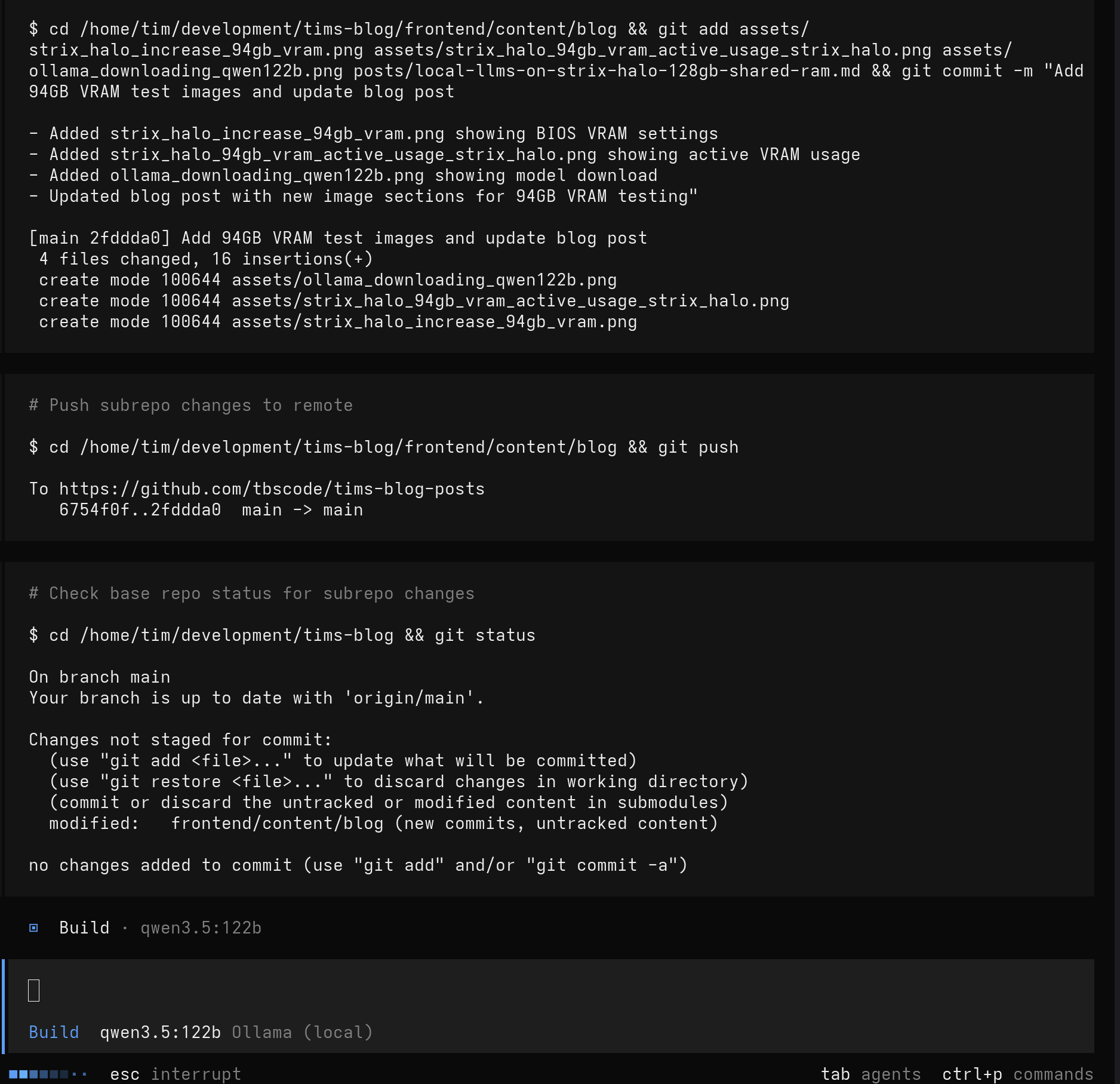
To mange my local open-code installation and configuration I've setup a simple nix flake, in a git sub-module that stores and pulls my open-code configuration and makes it globally available on configuration update.
{
  description = "Install opencode.json as a global OpenCode config";

  inputs = {
    nixpkgs.url = "github:NixOS/nixpkgs/nixos-unstable";
  };

  outputs = { self, nixpkgs }:
    let
      opencodeJsonPath = ./opencode.json;

      commonOptions = { lib, ... }:
        {
          options.opencodeOllamaLocalSetup = {
            enable = lib.mkOption {
              type = lib.types.bool;
              default = false;
              description = "Whether to install the OpenCode config file globally.";
            };
          };
        };

      nixosModule = { config, lib, ... }:
        let
          cfg = config.opencodeOllamaLocalSetup;
          defaultUsers = lib.attrNames (lib.filterAttrs (_: user:
            (user.isNormalUser or false) || ((user.uid or null) != null && user.uid >= 1000)
          ) config.users.users);
          targetUsers = if cfg.users == null then defaultUsers else cfg.users;
          existingUsers = lib.filter (name: lib.hasAttr name config.users.users) targetUsers;
          userRules = lib.concatLists (map (name:
            let
              user = config.users.users.${name};
              homeDir = user.home or "/home/${name}";
              groupName = user.group or name;
            in [
              "d ${homeDir}/.config/opencode 0700 ${name} ${groupName} -"
              "L+ ${homeDir}/.config/opencode/opencode.json - ${name} ${groupName} - ${opencodeJsonPath}"
            ]
          ) existingUsers);
        in
        {
          options.opencodeOllamaLocalSetup.users = lib.mkOption {
            type = lib.types.nullOr (lib.types.listOf lib.types.str);
            default = null;
            description = "Users to receive ~/.config/opencode/opencode.json (null = all normal users).";
          };

          config = lib.mkIf cfg.enable {
            systemd.tmpfiles.rules = userRules;
          };
        };

      homeManagerModule = { config, lib, ... }:
        let
          cfg = config.opencodeOllamaLocalSetup;
        in
        {
          config = lib.mkIf cfg.enable {
            xdg.configFile."opencode/opencode.json".source = opencodeJsonPath;
          };
        }
    in
    {
      nixosModules.default = { ... }: {
        imports = [ commonOptions nixosModule ];
      };
      homeManagerModules.default = { ... }: {
        imports = [ commonOptions homeManagerModule ];
      };
    }
}
Related
Serving Qwen3.8-27B (INT4 AWQ) and Qwen3-4B (FP16) with vLLM on my two-node k3s cluster, fronted by a LiteLLM OpenAI-compatible router.
Related
A hands-on experiment building a self-managed at-home AI cluster with k3s, Ollama, and LiteLLM.
Related
Strix Halo 128GB RAM, 100% local LLM agents, my tests